




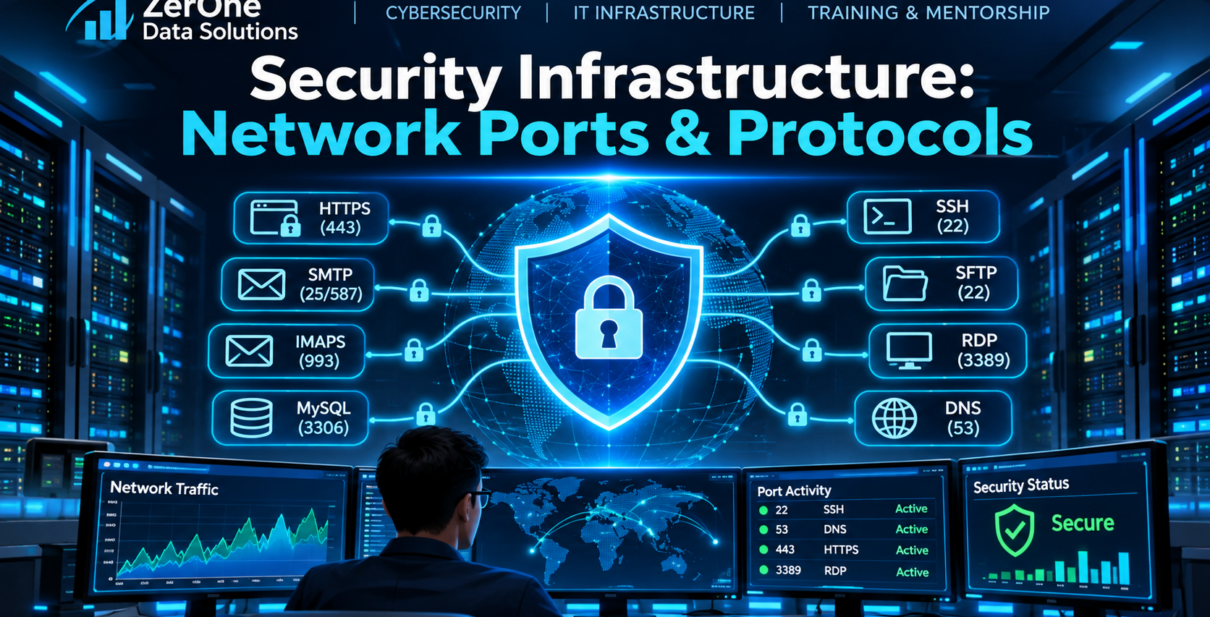
Understanding Security Infrastructure Pt.1: Network Ports, Protocols, and How to Secure Enterprise Communications
Watch the YouTube Video: https://youtu.be/ncsqRwr-NR4?si=c9Y_184vrmKjSLVe
An essential guide to understanding how devices communicate, why network protocols matter, and how organizations can protect their digital infrastructure against cyber threats.
Network Security
Cybersecurity Fundamentals
IT Infrastructure
Introduction: The Foundation of Network Security
Every time you visit a website, send an email, transfer a file, or remotely connect to a computer, a series of network communications takes place behind the scenes.
These communications depend on two fundamental networking concepts: ports and protocols.
Although these technologies make modern digital communication possible, they can also introduce security vulnerabilities when improperly configured or managed.
For cybersecurity professionals, understanding how ports and protocols work is essential to identifying potential attack surfaces, implementing appropriate security controls, and protecting enterprise infrastructure.
In this article, we explore the fundamentals of network ports and protocols, examine common security risks, and discuss practical measures organizations can implement to strengthen their network security posture.
-
Understanding Network Ports and Protocols
What is a network port?
A network port is a logical communication endpoint that helps direct incoming and outgoing network traffic to the appropriate application or service.
Think of an IP address as the street address of an office building, while network ports represent the individual office numbers within that building.
The IP address identifies the destination device, while the port number helps identify the application or service receiving the communication.
For TCP and UDP, port numbers are 16-bit values ranging from 0 to 65,535.
These ports are divided into three categories:
| Port category | Range | Purpose |
| Well-known | 0–1023 | Common network services |
| Registered | 1024–49151 | Application-specific services |
| Dynamic/private | 49152–65535 | Temporary or application-assigned communication |
Dynamic ports are frequently used as temporary source ports when client devices establish network connections.
What is a network protocol?
A network protocol is a standardized set of rules governing how devices exchange information.
Protocols define how data is formatted, transmitted, received, and interpreted across a network.
For example, when someone visits a secure website, HTTPS enables encrypted communication between the user’s browser and the web server.
Without standardized protocols, devices and applications would struggle to communicate reliably.
However, not all protocols provide the same level of security.
Many older protocols were developed when confidentiality and authentication were not primary design considerations. As cyber threats evolved, encrypted alternatives and additional security mechanisms became increasingly important.
-
Common Network Ports and Their Security Implications
Understanding commonly used network ports helps cybersecurity professionals recognize legitimate traffic, identify unusual activity, and configure security controls effectively.
The following table highlights several important protocols used in enterprise environments.
| Protocol | Default port | Primary function |
| FTP | TCP 21 | File transfer |
| SSH / SFTP | TCP 22 | Secure remote administration and file transfer |
| Telnet | TCP 23 | Unencrypted remote access |
| SMTP | TCP 25 | Email transmission |
| DNS | TCP/UDP 53 | Domain name resolution |
| HTTP | TCP 80 | Web communication |
| POP3 | TCP 110 | Email retrieval |
| IMAP | TCP 143 | Email access |
| HTTPS | TCP 443 | Encrypted web communication |
| SMB | TCP 445 | File and printer sharing |
| SMTP submission | TCP 587 | Authenticated email submission |
| IMAPS | TCP 993 | Encrypted IMAP |
| POP3S | TCP 995 | Encrypted POP3 |
| MySQL | TCP 3306 | Database communication |
| RDP | TCP/UDP 3389 | Remote desktop access |
These are commonly used default ports. Actual deployments may use alternative ports, and the presence of a particular port does not automatically guarantee secure communication.
-
Secure vs. Insecure Network Protocols
One of the most important principles of network security is recognizing the difference between protocols that protect transmitted information and those that expose it.
HTTP vs. HTTPS
HTTP traditionally operates on TCP port 80 and does not encrypt transmitted information.
This means an attacker positioned along the communication path may be able to observe or manipulate data exchanged between a client and server.
HTTPS addresses this problem by using Transport Layer Security (TLS) to encrypt communications.
HTTPS commonly uses port 443 and helps provide confidentiality, integrity, and server authentication.
For organizations, HTTPS should be the standard for websites, web applications, administrative interfaces, and services that transmit sensitive information.
Telnet vs. SSH
Telnet, commonly associated with TCP port 23, provides remote command-line access but transmits information without encryption.
This creates significant security concerns because usernames, passwords, and session information may be intercepted.
Secure Shell (SSH), typically operating on TCP port 22, provides encrypted remote access.
SSH is widely used for managing Linux servers, network devices, and other enterprise systems.
Organizations should disable Telnet wherever possible and adopt SSH with strong authentication and controlled administrative access.
FTP vs. SFTP and FTPS
Traditional File Transfer Protocol (FTP) does not encrypt credentials or file contents by default.
Consequently, sensitive information transferred through FTP may be exposed to interception.
Two common alternatives are:
- SFTP: Uses SSH, typically on TCP port 22, to provide encrypted file transfer.
- FTPS: Extends FTP using TLS to protect authentication and data transfers.
Although both support secure file transfer, SFTP and FTPS are different technologies and should not be confused.
-
Email Protocols and Communication Security
Email remains one of the most widely used communication technologies in business environments.
However, email infrastructure also represents a significant cybersecurity attack surface.
SMTP: Sending email
Simple Mail Transfer Protocol (SMTP) is used to transmit email between servers and support message submission.
SMTP commonly uses TCP port 25 for server-to-server delivery, while authenticated message submission commonly uses port 587 with STARTTLS.
Port 465 is also used for submissions over implicit TLS.
TLS can protect email traffic between communicating systems, although its effectiveness depends on configuration and whether encryption is required and properly validated.
POP3 and IMAP: Receiving email
POP3 and IMAP allow email clients to retrieve or access messages from mail servers.
POP3 traditionally uses port 110, while IMAP uses port 143.
Their encrypted variants commonly use:
- POP3S — TCP port 995
- IMAPS — TCP port 993
STARTTLS can also provide encrypted communication on the traditional POP3 and IMAP ports when correctly configured.
Organizations should enforce encrypted email connections, use strong authentication, and disable unnecessary legacy authentication mechanisms.
-
DNS Security: Protecting the Internet’s Address Book
The Domain Name System (DNS) translates human-readable domain names into IP addresses.
For example, when a user enters a website address into a browser, DNS helps identify the server associated with that domain.
DNS commonly uses UDP or TCP port 53.
However, traditional DNS was not designed to authenticate the origin of every response.
This creates opportunities for attacks such as DNS spoofing and cache poisoning, where malicious information can redirect users toward fraudulent destinations.
How DNSSEC helps
Domain Name System Security Extensions (DNSSEC) introduce cryptographic signatures that allow validating resolvers to verify the authenticity and integrity of signed DNS information.
DNSSEC helps protect against certain forms of DNS response manipulation.
However, DNSSEC does not encrypt DNS queries or hide browsing activity.
For organizations, DNS security should include DNSSEC validation where appropriate, secure resolver configuration, DNS filtering, and monitoring for suspicious domain activity.
-
Remote Desktop Protocol: Convenience and Security Risks
Remote Desktop Protocol (RDP) enables administrators and authorized users to access Windows systems remotely.
RDP commonly uses TCP and UDP port 3389.
Although RDP supports modern security features, poorly configured deployments can expose organizations to serious threats.
Common risks include unauthorized access, credential attacks, exploitation of unpatched systems, and lateral movement within compromised networks.
Organizations can reduce these risks by implementing modern TLS configurations, Network Level Authentication, multifactor authentication through appropriate access gateways, and strict network access controls.
Directly exposing RDP services to the public internet should generally be avoided. Secure VPNs, zero-trust access solutions, or properly configured remote desktop gateways provide more controlled access.
-
Other Important Enterprise Security Protocols
Beyond common web and email protocols, enterprise networks depend on several additional services.
These include:
| Protocol/service | Common port | Security consideration |
| DNS | 53 | Protect against spoofing and malicious resolution |
| DHCP | UDP 67/68 | Prevent rogue DHCP servers |
| SNMP | UDP 161/162 | Prefer SNMPv3 with authentication and privacy |
| LDAP | TCP/UDP 389 | Use protected connections where required |
| LDAPS | TCP 636 | TLS-protected directory communication |
| Kerberos | TCP/UDP 88 | Protect authentication infrastructure |
| Syslog | UDP 514 | Consider authenticated, encrypted logging |
| MSSQL | TCP 1433 | Restrict database access |
| MQTT | TCP 1883 | Avoid transmitting sensitive IoT data without protection |
| MQTT over TLS | TCP 8883 | Encrypt supported IoT messaging |
These services are especially important in environments that depend on centralized authentication, network monitoring, database infrastructure, and connected devices.
A poorly configured service may provide an attacker with an entry point into an otherwise well-protected environment.
-
Why Open Ports Can Become Security Risks
An open network port is not automatically a security vulnerability.
Organizations need open ports to deliver legitimate services.
The concern arises when services are unnecessary, outdated, improperly configured, or exposed to networks that should not have access.
For example, an organization might require a database server to communicate with an application server.
However, allowing unrestricted access to that database from the public internet could introduce unnecessary risk.
Attackers frequently conduct network reconnaissance to identify exposed services and discover potential weaknesses.
This is why organizations must understand not only which ports are open, but also which services are listening, who can access them, and whether those services are securely configured.
-
Best Practices for Securing Network Infrastructure
A secure enterprise network requires more than simply blocking suspicious traffic.
Organizations should adopt a layered security strategy that combines technology, governance, and continuous monitoring.
Implement least-privilege network access
Allow only the ports, protocols, and communication paths necessary for approved business operations.
Replace insecure protocols
Transition from Telnet to SSH, HTTP to HTTPS, and unencrypted file transfer to appropriately secured alternatives.
Segment enterprise networks
Separate sensitive systems and restrict unnecessary lateral communication between network segments.
Perform regular vulnerability assessments
Identify unnecessary open ports, outdated services, weak configurations, and exposed administrative interfaces.
Monitor network activity continuously
Use firewalls, intrusion detection and prevention systems, centralized logging, and security monitoring tools to identify suspicious communications.
Maintain patching and configuration standards
Regularly update operating systems, network devices, applications, and security protocols to address known vulnerabilities.
-
The Role of Ports and Protocols in Modern Cybersecurity
As enterprise environments become more complex, understanding network communication becomes increasingly important.
Organizations now operate across traditional data centers, cloud infrastructure, remote work environments, industrial networks, and Internet of Things (IoT) ecosystems.
Each environment introduces different communication requirements and security challenges.
A strong cybersecurity strategy must therefore account for how systems communicate, which services are exposed, and how access is controlled.
This is particularly relevant to Zero Trust security architecture, where network location alone should not determine whether communication is trusted.
Instead, organizations should continuously evaluate identities, devices, applications, and access requirements while enforcing appropriate security policies.
Conclusion: Building a Stronger Security Infrastructure
Network ports and protocols are essential building blocks of modern digital communication.
They enable websites to function, emails to travel, files to move between systems, and administrators to manage enterprise infrastructure.
However, these same communication mechanisms can introduce cybersecurity risks when deployed without adequate protection.
Understanding which protocols are secure, identifying unnecessary network exposure, and implementing appropriate access controls are fundamental responsibilities for cybersecurity professionals.
Effective network security begins with understanding how systems communicate—and controlling those communications appropriately.
By combining secure protocols, network segmentation, vulnerability management, and continuous monitoring, organizations can significantly reduce their attack surface and improve their overall cybersecurity resilience.
About ZerOne Data Solutions
ZerOne Data Solutions LLC provides cybersecurity consulting, technology training, and professional mentorship designed to help individuals and organizations develop practical technical knowledge and strengthen their security capabilities.
Through our cybersecurity training and mentorship programs, we explore foundational and advanced topics including network security, security infrastructure, threat detection, cloud security, and enterprise cybersecurity architecture.
Whether you are beginning your cybersecurity journey or seeking to enhance your professional expertise, understanding network ports and protocols is an important step toward developing stronger cybersecurity skills.
Explore more cybersecurity training and educational resources at ZerOne Data Solutions.